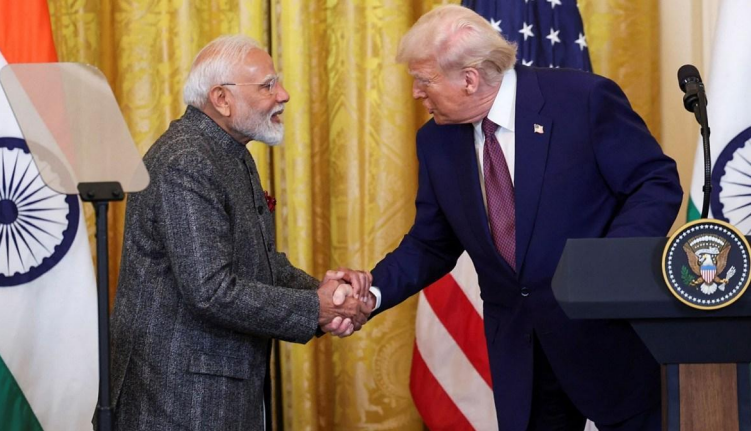
The United States has invited India to become part of a proposed international body, informally described as a “Board of Peace”, aimed at overseeing stability, governance and reconstruction in Gaza after months of conflict. The invitation, extended by Donald Trump, places India at the centre of an unconventional diplomatic initiative that could reshape how post-conflict zones are managed outside traditional United Nations frameworks.
While New Delhi has not yet formally responded, the outreach itself reflects a notable shift in global diplomacy. Washington is seeking to anchor peace-building efforts not only in Western alliances, but also among rising powers with strategic autonomy, credibility across blocs, and experience in humanitarian and development engagement.
What the ‘Board of Peace’ Proposes
The proposed Board of Peace is envisioned as a multinational platform tasked with guiding Gaza’s transition from conflict to recovery. According to officials familiar with the proposal, the body would focus on reconstruction coordination, interim governance support, humanitarian stabilisation and security oversight during the post-war phase.
Unlike UN-led missions, the Board is designed as a compact decision-making forum, comprising select countries willing to contribute funding, technical expertise and diplomatic leverage. Trump has argued that such a structure would avoid institutional paralysis and accelerate on-ground outcomes, a criticism he has long levelled at multilateral organisations.
Gaza’s future governance remains one of the most complex questions in Middle East diplomacy. With infrastructure severely damaged, civilian systems weakened and political legitimacy fragmented, any reconstruction effort faces the challenge of delivering aid while preventing a relapse into instability.
Why India Matters in the Gaza Equation
India’s inclusion is neither symbolic nor accidental. As one of the world’s fastest-growing major economies and a country that maintains working relations across rival geopolitical camps, India occupies a rare diplomatic space. It has long supported a two-state solution, sustained defence and technology ties with Israel, and consistently delivered humanitarian assistance to Palestinian territories.
Under recent leadership, India has also expanded its role in global governance — from the G20 presidency to active participation in climate finance, digital public infrastructure and development partnerships. Washington’s invitation reflects an assessment that India brings both political credibility and administrative capacity to complex international missions.
Accepting such a role, however, would mark a deeper level of engagement for India in Middle Eastern security affairs. Traditionally cautious about formal peacekeeping mandates beyond the UN framework, New Delhi will weigh the diplomatic gains against the risks of entanglement in a deeply polarised conflict.
Global Reactions and Strategic Undercurrents
The proposal has generated mixed reactions internationally. Some governments see the Board of Peace as a pragmatic attempt to bypass diplomatic gridlock and mobilise reconstruction resources quickly. Others express concern that parallel mechanisms could weaken established international norms or marginalise Palestinian political agency.
Several countries across Europe, Asia and the Middle East have reportedly received similar invitations, indicating that Washington is pursuing a broad coalition rather than a narrow alliance. Yet the absence of a clearly defined legal mandate, voting structure or accountability framework has raised questions among diplomats about how decisions would be enforced on the ground.
For the United States, the initiative aligns with Trump’s preference for deal-driven diplomacy focused on outcomes rather than institutions. For participating countries, the challenge lies in balancing influence with responsibility, especially in a region where missteps carry global repercussions.
Implications for India’s Global Role
If India chooses to engage, it would reinforce its image as a stabilising power capable of contributing to peace beyond its immediate neighbourhood. Participation could strengthen India’s strategic dialogue with the US while preserving its independent voice on Middle East issues — a balance New Delhi has carefully maintained.
At the same time, involvement in Gaza’s reconstruction would require navigating sensitive political terrain, including coordination with regional actors, managing humanitarian expectations, and avoiding perceptions of bias. India’s track record in development assistance and post-conflict capacity-building may offer advantages, but the scale and visibility of Gaza make this a far more complex undertaking.
Domestically, such a move would also be closely scrutinised, as foreign policy engagement increasingly intersects with public opinion and global positioning.
A Test Case for Future Peace Governance
The invitation to India underscores a broader question confronting international diplomacy: are traditional multilateral institutions sufficient for today’s conflicts, or will smaller, issue-specific coalitions increasingly take their place?
The proposed Board of Peace is still conceptual, but its implications are tangible. If implemented effectively, it could offer a model for faster post-conflict recovery. If not, it risks adding another layer to an already crowded diplomatic landscape.
As India deliberates its response, the decision will resonate well beyond Gaza, shaping perceptions of India’s willingness to help define new rules of global peace-building in an era of shifting power and persistent conflict.