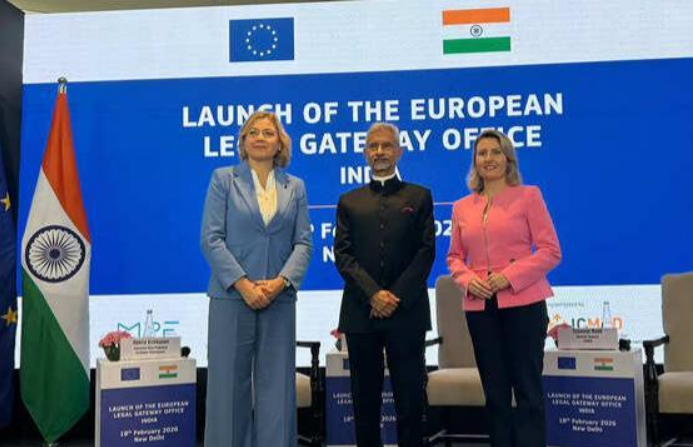
The European Union has formally inaugurated the European Legal Gateway Office in New Delhi, marking a significant institutional development in India–EU relations. The launch, held at the EU Delegation premises in the capital, reflects a strategic shift toward structured, transparent and rules-based mobility cooperation between India and the 27-member European bloc. Senior European diplomats, Indian government officials and policy stakeholders attended the event, underscoring its diplomatic importance.
The initiative comes at a time when India and the European Union are deepening engagement across trade, technology, digital governance and geopolitical coordination. With bilateral trade in goods exceeding €120 billion annually in recent years, and negotiations progressing on a comprehensive Free Trade Agreement, both sides are placing increased emphasis on human capital exchange as a pillar of long-term cooperation.
European officials described the Legal Gateway Office as a facilitation and coordination platform designed to provide clarity on legal migration routes, professional qualification recognition and regulatory compliance. The move signals growing recognition that mobility frameworks are central to economic diplomacy in an increasingly interconnected global economy.
1. Strategic Context of the Launch
The inauguration of the Legal Gateway Office is embedded within a broader strategic recalibration of India–EU ties. Over the past few years, Brussels and New Delhi have intensified engagement under mechanisms such as the India–EU Trade and Technology Council, focusing on digital transformation, supply-chain resilience and sustainable growth. Mobility cooperation is now emerging as a complementary dimension of this evolving partnership.
European policymakers have repeatedly acknowledged India’s demographic advantage and growing skilled workforce. With more than half of India’s population under the age of 30, the country represents one of the largest pools of technology professionals, engineers, healthcare workers and researchers globally. European industries, meanwhile, are facing structural skill shortages in digital technology, green energy, advanced manufacturing and healthcare sectors.
The Legal Gateway Office therefore represents more than administrative reform; it reflects strategic convergence. By institutionalising advisory support for legal mobility, both India and the EU aim to create a predictable and mutually beneficial system that strengthens long-term economic and political alignment.
2. Facilitating Legal Pathways for Students and Professionals
A core function of the European Legal Gateway Office is to centralise verified information regarding legal entry procedures into EU member states. This includes guidance on student visas, work permits, recognition of professional qualifications and compliance with national immigration laws. European officials clarified that the office will not process applications but will function as a structured advisory and coordination mechanism.
Indian students have increasingly chosen European universities for higher education, particularly in STEM disciplines. Germany, France, Ireland and the Netherlands have reported steady growth in Indian enrolments over the past decade. By simplifying information access and clarifying documentation requirements, the Gateway aims to reduce administrative uncertainty and procedural delays.
For skilled professionals, the office provides clarity on sector-specific labour market demands. IT specialists, engineers, healthcare workers and researchers constitute a significant share of Indian professionals working in Europe. Structured legal pathways are expected to strengthen compliance, reduce misinformation and ensure smoother cross-border mobility aligned with EU regulatory frameworks.
3. Economic Implications and Trade Synergies
The mobility framework carries substantial economic implications. The European Union remains one of India’s largest trading partners, with goods trade surpassing €120 billion annually and services trade steadily expanding. Enhanced professional mobility supports bilateral trade by facilitating business operations, technology transfer and cross-border corporate collaboration.
European industries facing labour shortages view Indian talent as a vital contributor to sustaining productivity and innovation. In sectors such as artificial intelligence, renewable energy, cybersecurity and advanced manufacturing, skilled mobility supports research and industrial competitiveness. Analysts note that human capital exchange is increasingly linked to global value chain integration.
From India’s perspective, improved access to European labour markets strengthens outward economic engagement. Exposure to global regulatory standards, innovation ecosystems and research institutions contributes to domestic skill enhancement and entrepreneurship. The Legal Gateway Office thus operates within a broader economic architecture connecting mobility, trade and technology cooperation.
4. Regulatory Coordination and Governance Standards
European officials emphasised that the Legal Gateway Office will function within strict regulatory and compliance frameworks. Immigration policies remain under the jurisdiction of individual EU member states, but the Gateway will coordinate consistent information dissemination while respecting national sovereignty and EU-wide standards.
Data protection, labour rights and verification procedures remain integral to the initiative. European representatives underscored that transparency and accountability are essential to maintaining trust in legal migration systems. The advisory model aims to prevent exploitation by unofficial intermediaries and ensure applicants receive accurate, government-backed information.
Indian authorities welcomed the initiative as a step toward reducing irregular migration risks while protecting workers’ rights abroad. Institutional coordination between Indian and European agencies is expected to improve oversight, strengthen compliance mechanisms and enhance bilateral trust in migration governance.
5. Future Outlook
The establishment of the European Legal Gateway Office signals a broader transformation in India–EU engagement. Mobility is no longer treated as a peripheral issue but as a strategic pillar of economic and diplomatic cooperation. As trade negotiations advance and digital partnerships deepen, structured talent exchange is likely to remain central to bilateral discussions.
Policy observers suggest that the Gateway could evolve into a broader platform supporting research collaboration, startup partnerships and vocational training programmes. Targeted outreach initiatives and industry-specific mobility dialogues may further institutionalise cooperation in emerging sectors such as artificial intelligence and green technology.
In a global environment defined by demographic imbalances and rapid technological change, structured mobility frameworks are becoming instruments of strategic diplomacy. The EU’s decision to establish the Legal Gateway Office in New Delhi reflects recognition of India’s growing importance as a talent powerhouse. For both partners, the initiative represents an investment in long-term stability, innovation and shared economic growth.