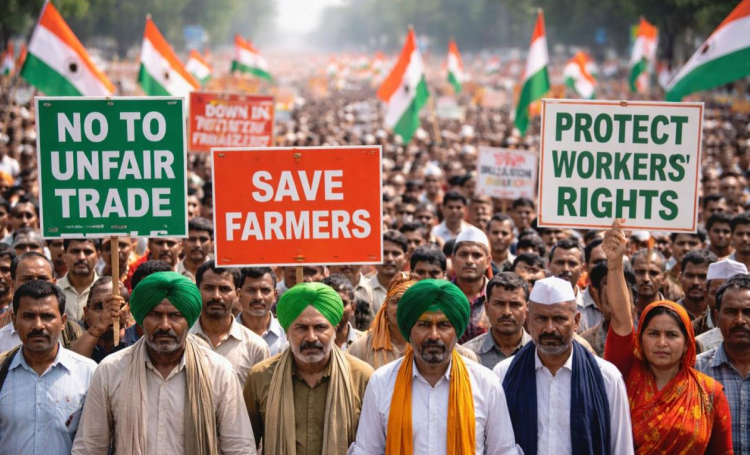
Trade unions and farmer organisations across India announced a nationwide Bharat Bandh today, calling for coordinated protest action against the recently concluded India–United States trade agreement. The announcement, made during joint press briefings in New Delhi and several state capitals, signals a significant escalation in opposition to specific provisions of the bilateral framework, particularly those concerning agriculture, tariff adjustments and market access.
Organisers stated that the bandh is intended to mobilise workers, farmers, small traders and transport associations in a collective expression of dissent. According to preliminary coordination statements issued this morning, participation is expected from multiple central trade unions and regional farmer bodies. While essential services are to remain operational, sectors such as banking, transport, wholesale markets and educational institutions could face varying degrees of disruption depending on state-level mobilisation.
Scale of Mobilisation and Expected Disruptions
Representatives from several national trade federations confirmed that workers across public and private sectors have been urged to participate in the bandh. In states such as Punjab, Haryana, Uttar Pradesh, Maharashtra and West Bengal, district-level committees have reportedly begun coordinating protest marches, road demonstrations and temporary market closures. Transport unions in select regions have indicated possible suspension of bus and goods-carrier services during peak protest hours.
Banking services may operate with reduced staffing levels in some urban centres, while agricultural mandis in parts of northern India are expected to suspend trading activity. Organisers clarified that emergency services, hospitals and essential utilities will remain exempt from protest action. State administrations have reportedly initiated precautionary security arrangements to maintain law and order and ensure continuity of critical services.
Core Objections to the Trade Agreement
Farmer organisations have voiced concern that certain agricultural provisions within the trade agreement could increase exposure to subsidised imports, potentially affecting domestic crop pricing and procurement stability. Leaders from prominent agricultural unions stated that safeguards protecting minimum support price mechanisms must be explicitly reinforced to prevent adverse impacts on small and marginal farmers.
Trade unions have also raised apprehensions regarding labour-intensive sectors such as textiles, pharmaceuticals and small-scale manufacturing. According to protest organisers, tariff concessions and regulatory alignments may disproportionately benefit large corporations while placing competitive pressure on micro and small enterprises. During a joint statement issued today, union leaders called for greater transparency and wider stakeholder consultation before the full implementation of the agreement.
Government Position and Strategic Justification
Senior government officials have defended the India–U.S. trade agreement as a strategic milestone aimed at expanding export opportunities and strengthening bilateral economic ties. According to official briefings earlier this week, the deal is expected to enhance market access for Indian goods in sectors such as pharmaceuticals, information technology services, engineering products and agricultural exports. Authorities emphasised that sensitive sectors remain protected under negotiated safeguard clauses.
Government representatives also reiterated that the agreement aligns with India’s broader objective of increasing global trade integration while maintaining domestic economic stability. Officials have invited trade union leaders and farmer representatives to engage through institutional dialogue channels to address concerns. The administration has underscored that economic reforms must balance growth ambitions with social and sectoral protections.
Economic Implications and Market Sentiment
Financial analysts are closely monitoring developments following today’s bandh announcement. Market participants noted that while short-term volatility may occur in transportation and supply-chain-linked sectors, a single-day protest is unlikely to significantly alter macroeconomic fundamentals. However, prolonged or recurring disruptions could impact daily output in logistics, retail trade and commodity markets.
Industry associations have urged both the government and protest groups to pursue constructive dialogue to avoid uncertainty that may affect investor confidence. Economists suggest that clear communication regarding the implementation roadmap of the trade agreement will be essential to stabilise sentiment. They added that India’s broader growth trajectory remains influenced by export performance, domestic consumption and global demand cycles.
Political and Social Context
The Bharat Bandh announcement reflects ongoing political debate surrounding trade liberalisation and global economic integration. Observers note that nationwide shutdowns historically serve as platforms for broader socio-economic grievances, amplifying sector-specific concerns into national discourse. The timing of today’s call coincides with heightened parliamentary discussions on economic reforms and international trade partnerships.
Social analysts highlight that such protests underscore the complex balancing act between global competitiveness and domestic protection. While the government positions the trade agreement as a long-term growth catalyst, labour and farmer groups seek assurances that structural adjustments will not disadvantage vulnerable communities. The outcome of today’s mobilisation may influence the tenor of policy dialogue in the weeks ahead.
Conclusion
The announcement of a nationwide Bharat Bandh today marks a significant moment in India’s ongoing debate over the India–U.S. trade agreement. As trade unions and farmer organisations mobilise across states, the government maintains that the deal strengthens India’s global economic standing. The coming days will determine whether the protest action leads to renewed negotiations, policy clarifications or broader political engagement on the future direction of India’s trade strategy.