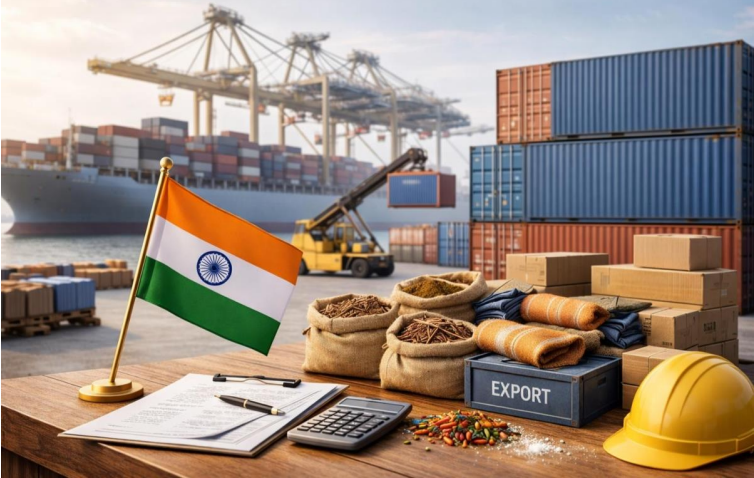
In a decisive policy response to escalating geopolitical disruptions in West Asia, the Government of India has launched a ₹497 crore support initiative titled the Resilience & Logistics Intervention for Export Facilitation (RELIEF) scheme.
The programme is aimed at protecting Indian exporters from the cascading impact of rising freight costs, insurance premiums, and shipping delays that have severely affected trade flows through one of India’s most critical export corridors.
As tensions in the Gulf region continue to disrupt maritime logistics, the scheme marks a timely intervention to stabilise export activity and prevent deeper economic fallout.
The RELIEF scheme has been introduced under the broader Export Promotion Mission and is being implemented through the Export Credit Guarantee Corporation of India (ECGC), a government-backed entity that provides insurance support to exporters.
By leveraging an existing institutional framework, the government has sought to ensure rapid deployment and targeted assistance, particularly for exporters operating in high-risk trade routes.
The urgency of the intervention reflects the scale of disruption in India’s trade linkages with West Asia, a region that accounts for a significant share of the country’s export activity.
With consignments delayed, shipping routes altered, and costs escalating sharply, exporters—especially small and medium enterprises—have faced mounting financial strain.
The RELIEF scheme therefore represents not only a financial package but also a strategic measure to safeguard India’s position in global trade during a period of heightened uncertainty.
Strategic Context: Trade Disruptions and Economic Risk
The launch of the RELIEF scheme is rooted in the severe logistical disruptions triggered by geopolitical tensions in the Gulf and surrounding maritime corridors.
Shipping routes through critical passages such as the Strait of Hormuz have become increasingly volatile, leading to vessel diversions, congestion at ports, and longer transit times.
These disruptions have significantly increased operational costs for exporters and introduced uncertainty into supply chains that were previously stable.
One of the most immediate impacts has been the sharp rise in freight rates and insurance premiums.
War-risk surcharges and emergency fees imposed by shipping companies have made it difficult for exporters to maintain cost competitiveness in international markets.
For many businesses, particularly MSMEs operating on thin margins, these additional costs are difficult to absorb or pass on to buyers, raising the risk of order cancellations and loss of market share.
In this context, the government’s intervention is aimed at preventing a broader economic ripple effect.
Exports are a key driver of India’s growth and employment, and disruptions in major trade corridors can have cascading consequences across industries, from manufacturing to logistics.
By stepping in with financial and logistical support, the RELIEF scheme seeks to contain these risks and ensure continuity in trade flows during a period of global instability.
Structure of the RELIEF Scheme
The RELIEF scheme has been designed as a three-component intervention, each targeting a specific category of exporters and addressing distinct challenges arising from the crisis.
1. Support for Existing ECGC Policyholders
The first component focuses on exporters who already have ECGC insurance coverage, providing enhanced protection for shipments affected during the disruption period.
It also includes automatic extensions of export obligations under schemes such as Advance Authorisation and EPCG, offering immediate relief from compliance pressures.
2. Coverage for Future Shipments
The second component is aimed at future shipments, encouraging exporters to continue trade activities despite heightened risks.
Under this provision, ECGC will provide expanded insurance coverage for upcoming consignments, ensuring that exporters remain protected against potential losses.
3. MSME-Focused Financial Assistance
The third and most substantial component is dedicated to MSMEs, which are particularly vulnerable to sudden cost increases.
This segment includes partial reimbursement of additional freight and insurance expenses, with financial support estimated at around ₹282 crore.
By directly addressing cost pressures faced by smaller exporters, the scheme seeks to preserve their participation in global markets and protect employment in export-linked sectors.
Geographic Scope and Sectoral Coverage
The RELIEF scheme covers a wide range of countries in the Gulf and West Asia region, including the UAE, Saudi Arabia, Qatar, Kuwait, Oman, Bahrain, Iraq, Iran, Israel and Yemen.
These markets are strategically important for India, collectively accounting for a substantial share of its export volume across sectors such as petroleum products, engineering goods, textiles and food items.
The disruption in these markets has had a direct impact on Indian exporters, with reports of shipments failing to reach their destinations and payment cycles being delayed.
This has created liquidity challenges and increased financial risk, particularly for businesses with significant exposure to the region.
By targeting these specific geographies, the scheme ensures that support is directed where it is most needed.
In addition to its geographic focus, the scheme spans multiple sectors, reflecting the diverse nature of India’s export economy.
From manufacturing and agriculture to services and logistics, the impact of the crisis has been widespread.
The RELIEF initiative therefore adopts a comprehensive approach, addressing both sector-specific challenges and broader systemic risks in the export ecosystem.
Institutional Mechanism and Policy Coordination
The implementation of the RELIEF scheme is anchored in a coordinated institutional framework involving multiple government agencies.
The ECGC serves as the primary implementing body, responsible for providing insurance coverage, processing claims and ensuring efficient disbursement of funds.
Its role is critical in translating policy intent into tangible support for exporters.
To monitor the evolving situation, the government has also established a high-level inter-ministerial group comprising representatives from key departments, including commerce, finance, shipping, and external affairs.
This group is tasked with tracking disruptions, coordinating policy responses and recommending adjustments to the scheme as required.
Such coordination reflects a broader shift in India’s economic governance, where rapid response mechanisms are increasingly being deployed to address external shocks.
By integrating policy, financial support and operational monitoring, the RELIEF scheme exemplifies a proactive approach to managing trade risks in a volatile global environment.
Economic Impact and Strategic Significance
The RELIEF scheme carries significant implications for India’s economic trajectory, particularly in terms of export stability and global competitiveness.
By mitigating the impact of rising costs and logistical disruptions, the initiative helps ensure that Indian exporters can continue to fulfil orders and maintain their presence in international markets.
This is crucial for preserving the country’s share in key export destinations.
The scheme also plays an important role in supporting MSMEs, which form the backbone of India’s export sector.
By providing targeted financial assistance and reducing operational risks, the government aims to protect employment and sustain industrial activity.
In doing so, it reinforces the resilience of the domestic economy against external shocks.
At a broader level, the initiative reflects India’s strategic approach to navigating global uncertainties.
As geopolitical tensions reshape trade dynamics, the ability to respond swiftly and effectively becomes a critical determinant of economic success.
The RELIEF scheme thus represents not only a short-term support measure but also a long-term signal of policy agility and resilience.
Outlook
The launch of the ₹497 crore RELIEF scheme marks a significant milestone in India’s economic policy response to global disruptions.
By addressing the immediate challenges faced by exporters and providing a structured framework for support, the government has taken a proactive step toward safeguarding trade and economic stability.
In the near term, the effectiveness of the scheme will depend on its implementation and the ability.