India’s Creator Economy Is Becoming a Real Business Industry
India’s creator economy is evolving into a major business ecosystem, changing how brands reach consumers, how creators earn money, and how digital businesses are built.
For years, content creation in India was largely viewed as a social-media activity. People made videos, posted photographs, shared opinions and built audiences on platforms such as YouTube and Instagram, often as a side activity alongside college, employment or other businesses. Today, that perception is changing. The creator economy is increasingly becoming a structured part of India’s digital economy, connecting creators with brands, consumers, technology platforms and new forms of commerce. What was once described simply as “influencing” is gradually becoming a broader business ecosystem built around content, community, attention and trust.
The scale of this transformation is becoming difficult to ignore. A 2026 study by the Srini Raju Centre for IT and the Networked Economy at the Indian School of Business, in collaboration with Hashfame, estimates that India’s creator base increased from approximately 0.96 million in 2020 to 4.12 million in 2025. The report also found that 66% of India’s creators are now based in non-metro markets, showing that the creator economy is no longer concentrated primarily in cities such as Mumbai, Delhi or Bengaluru. Uttar Pradesh and Maharashtra together account for nearly one-quarter of the country’s creators, while several other states are also developing significant creator communities.
This geographical expansion is important because it changes the idea of who can participate in the digital economy. A creator no longer necessarily needs to live in a major metropolitan city or work for a media company to reach a large audience. A smartphone, an internet connection and a specific area of knowledge or interest can become the starting point for a digital business. A food creator in a smaller city can build an audience around regional cuisine, a farmer can share agricultural knowledge, a teacher can create educational content, and a fashion creator can build a community around affordable clothing and local brands. As regional-language content continues to grow, creators can connect with audiences that traditional national advertising may not always reach with the same level of relevance.
The creator economy is also becoming more closely connected to consumer spending. A 2025 report by Boston Consulting Group estimated that India had more than 2–2.5 million monetised content creators influencing over $350–400 billion in consumer spending. The report projected that creator-influenced consumption could exceed $1 trillion by 2030. These figures illustrate an important shift: creators are not only producing content for audiences; they are increasingly participating in the journey through which consumers discover, evaluate and purchase products and services.
This is one reason businesses are paying greater attention to creators. Traditional advertising generally places a brand message in front of an audience, while creator-led marketing can combine the product with an existing relationship between the creator and their community. A creator may demonstrate how a product works, explain why they use it, compare alternatives or incorporate it into their regular content. The commercial value therefore comes not only from the number of followers but also from relevance, credibility and engagement within a particular community.
The broader advertising market is moving in the same direction. According to the FICCI-EY report released in March 2026, India’s media and entertainment sector reached ₹2.78 trillion in 2025, growing 9% during the year. Digital advertising grew 26% to ₹947 billion and accounted for 63% of total advertising revenues. The report also noted that digital media crossed ₹1 trillion in revenue for the first time, becoming the largest segment of India’s media and entertainment industry.
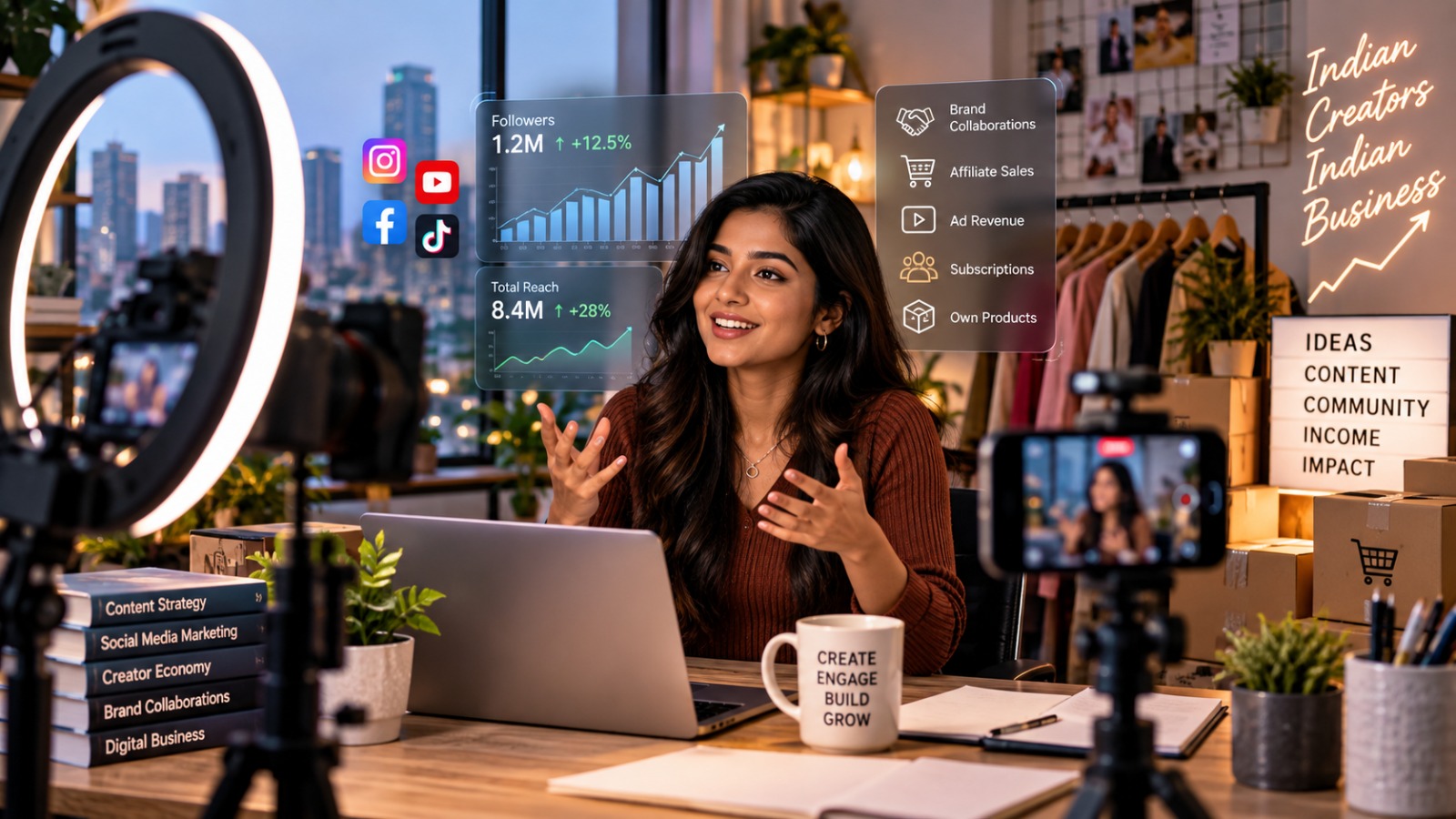
For creators, however, brand collaborations are only one part of the opportunity. The business model is becoming increasingly diverse. Creators can earn through advertising revenue, brand partnerships, affiliate commerce, subscriptions, digital products, live commerce, virtual gifting, events and their own products or businesses. These different monetisation avenues allow successful creators to move beyond simply selling their audience's attention to building businesses around the communities they have developed.
This creates an interesting transition from creator to entrepreneur. A creator who initially starts by posting videos about fitness, food, technology or fashion may eventually launch a product, build an online community, organise events or develop a direct-to-consumer brand. In such cases, the audience becomes more than a collection of followers. It becomes a potential customer base, feedback network and distribution channel. The creator's personal brand can therefore become an asset that supports multiple revenue streams.
The same development is visible from the perspective of businesses. Companies are increasingly looking beyond celebrities with millions of followers and exploring creators who have smaller but highly engaged communities. A creator who focuses entirely on personal finance, for example, may have a smaller audience than a general entertainment creator but could be more relevant to a financial-services brand. Similarly, a regional food creator may offer a food company access to a very specific consumer segment. This has pushed the creator economy towards a more segmented model where relevance and audience fit can matter alongside overall reach.
The growth outside India's largest cities makes this development even more significant. According to the ISB–Hashfame study, non-metro creators represented 66% of India's creator base in 2025, and the number of creators outside metropolitan markets grew 6.4 times between 2020 and 2025, compared with 2.6 times in metro markets. This suggests that the next phase of India's creator economy may be increasingly shaped by regional markets, languages and communities rather than being driven only by India's largest urban centres.
Regional content can also create new opportunities for businesses that previously struggled to reach fragmented markets. India is home to hundreds of languages and a wide range of cultural preferences, purchasing behaviours and local identities. Digital platforms allow creators to serve these smaller communities at a scale that traditional media may find difficult to replicate. A creator who understands the culture, language and interests of a particular region can become an important bridge between national brands and local consumers.
But the growth of the creator economy does not automatically mean that every creator can build a sustainable business. One of the biggest challenges is the difference between participation and monetisation. The ISB–Hashfame research indicates that while India's creator base has expanded rapidly, sustainable earning opportunities remain uneven. Most creators still secure only a limited number of paid brand campaigns, highlighting the gap between becoming a creator and generating reliable income from content.
This distinction is important for understanding the industry's future. A large number of people creating content does not necessarily translate into a large number of financially sustainable creator businesses. The ecosystem still faces challenges involving inconsistent income, platform dependence, audience measurement, fake engagement and the ability of brands to accurately measure return on investment. As the industry grows, creators and businesses will need better systems for measuring genuine engagement, building trust and demonstrating the commercial value of creator partnerships.
Technology is likely to play an important role in solving some of these challenges. Artificial intelligence is already changing how digital content is produced, from generating ideas and scripts to editing, translation, dubbing and audience analysis. For creators working with small teams, these tools can reduce the time required for repetitive production tasks and make it easier to produce content in multiple formats and languages. Generative AI is also expected to influence content creation, production efficiency and monetisation across India's media and entertainment industry.
At the same time, technology does not eliminate the importance of originality and trust. As AI makes content production faster and cheaper, the amount of digital content available to consumers is likely to increase further. This could make genuine expertise, personality and community relationships more valuable rather than less important. A creator may use AI to edit a video or translate it into another language, but the reason an audience chooses to watch that creator may still be the trust and connection developed over time.
This also explains why the creator economy should not be viewed simply as another branch of social media. It increasingly sits at the intersection of media, advertising, retail, technology and entrepreneurship. A creator can simultaneously function as a publisher, marketer, community builder, product researcher and entrepreneur. Platforms provide distribution, brands provide commercial demand, technology enables production and analytics, while audiences determine which creators are able to maintain relevance.
The business opportunity extends beyond individual creators as well. As the ecosystem grows, it creates demand for agencies, creator-management platforms, video editors, production teams, analytics companies, social-commerce tools, payment solutions and other services designed specifically for creators. This means the creator economy can generate economic activity even when a business is not itself a content creator. An entire supporting ecosystem is developing around the people and companies producing digital content.
For brands, this changing environment also requires a different approach to marketing. One-off promotional posts may continue to exist, but long-term partnerships can allow creators to integrate products more naturally into their content and provide brands with a deeper understanding of specific audiences. Businesses will increasingly need to consider not just how many people a creator can reach, but who those people are, how they engage with the content and whether that audience is relevant to the brand.
The next phase of India's creator economy is therefore likely to be less about simply increasing the number of people who create content and more about improving the quality and sustainability of the businesses built around that content. The ISB–Hashfame research describes this shift as a movement from participation towards productivity, reflecting a broader maturation of the ecosystem.
India's creator economy is still evolving, but its direction is becoming clearer. Millions of creators are building audiences across metros and smaller cities, brands are moving more advertising activity into digital channels, and new monetisation models are allowing creators to turn attention into commerce. At the same time, challenges around income stability, measurement, trust and platform dependence show that the industry is still developing.
The most significant change may therefore be the way society views content creation itself. It is no longer limited to entertainment or social-media influence. For many creators, content has become the foundation on which a wider business can be built. As India's digital economy continues to expand, the creator may increasingly be seen not simply as someone who posts online, but as a new kind of entrepreneur—one who builds a business around ideas, audiences, communities and trust.
To read more insights on India’s evolving startup and business landscape, visit Startup Times.

Leave a comment
Your email address will not be published. Required fields are marked *
Add a newsletter to your widget area.
Top Stories