
The Rise of Boring Businesses: Why Indian Startups Are Building for Traditional Industries
Indian startups are increasingly using technology to solve long-standing problems in traditional industries such as manufacturing, logistics, agriculture, construction and waste management.
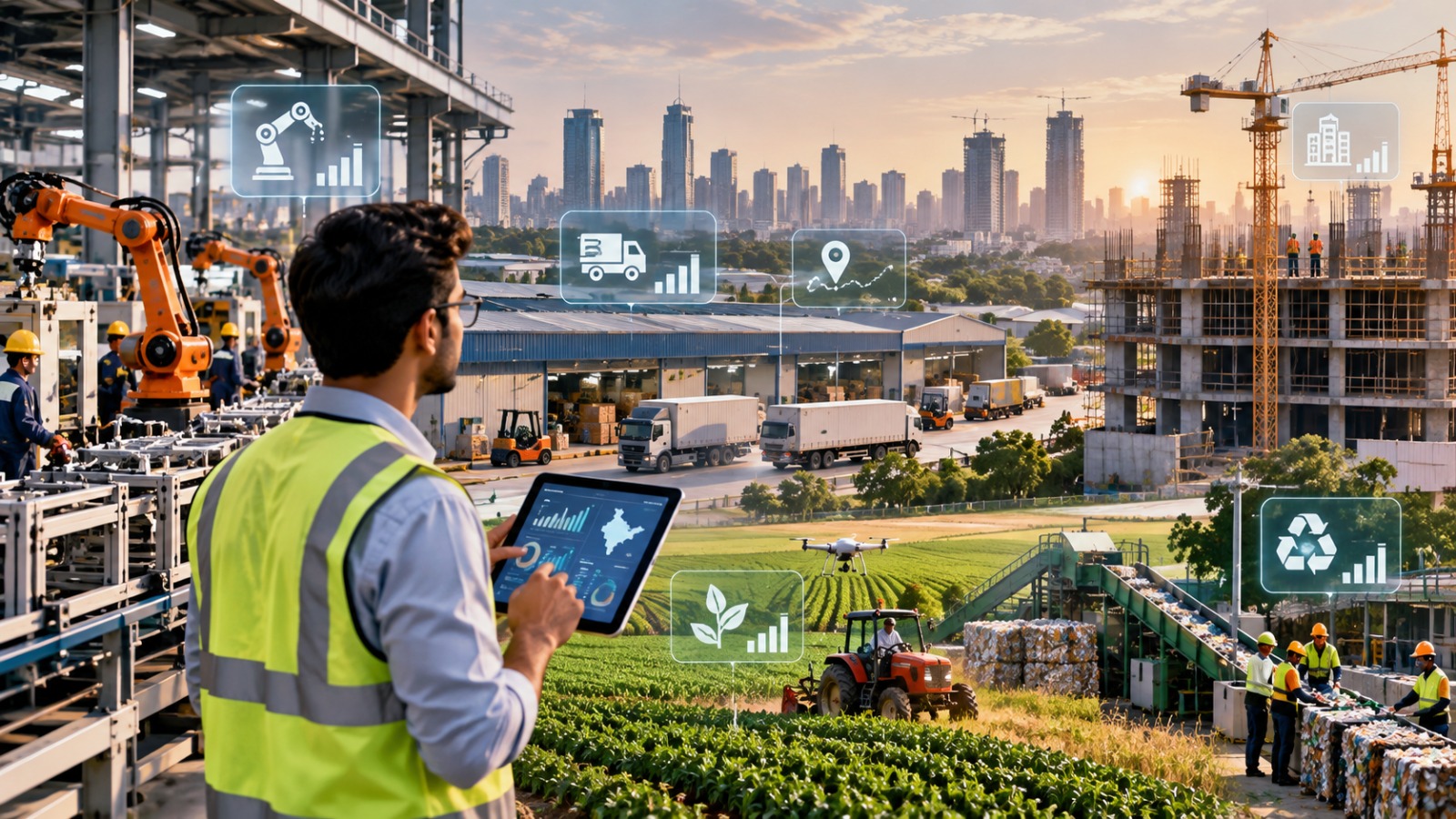
For years, the Indian startup story was dominated by consumer apps, food delivery platforms, fintech companies and online marketplaces. The most visible startups were usually the ones that appeared directly on consumers’ smartphones. But beneath this familiar startup narrative, another category of businesses has been quietly developing. These companies are building technology for industries that may not appear particularly glamorous but are essential to how the economy functions. Manufacturing, logistics, agriculture, construction, waste management, industrial procurement and supply-chain operations are increasingly becoming areas of innovation.
These businesses are sometimes described as “boring businesses” because they do not necessarily have the immediate excitement associated with social media platforms or consumer apps. Yet the problems they address can be much larger and more fundamental. Moving goods efficiently, reducing factory downtime, managing agricultural production, sourcing industrial materials, improving construction processes or handling waste are problems that affect millions of businesses and consumers. For startups, solving these problems can mean entering large markets where even small improvements in efficiency can create significant economic value.
India already has a broad startup presence across these sectors. Startups are increasingly working across agriculture, construction, logistics, automotive, green technology, manufacturing and other industries. This reflects a wider change in the ecosystem: technology is increasingly being applied not only to create new consumer experiences, but also to improve the systems that support the existing economy.
One of the biggest reasons traditional industries are attracting entrepreneurs is the sheer size of the problems involved. A consumer application may need to convince people to download and use a new product, but a startup working with a manufacturer, logistics company or agricultural enterprise may be solving an existing operational problem. The customer already understands the problem; what they need is a better solution. This can create opportunities for startups that are able to combine industry knowledge with software, automation, data and artificial intelligence.
Manufacturing is a particularly important example. India's industrial development is increasingly focused on moving beyond simple assembly towards higher-value manufacturing, stronger domestic supply chains, research and development and greater participation in global value chains. Manufacturing, digital technologies, green industrialisation and Industry 4.0 are becoming important areas in India's industrial transformation.
This transformation creates opportunities for technology startups. A factory does not necessarily need another consumer-facing application; it may need software that predicts when a machine is likely to fail, sensors that monitor production, computer vision that detects defects, systems that manage inventory or platforms that help businesses coordinate suppliers. These solutions may not be visible to the average consumer, but they can directly influence productivity, costs and profitability.
Artificial intelligence is also changing what is possible in these industries. AI can be used to analyse manufacturing data, identify defects, forecast demand, optimise routes, monitor equipment and assist businesses in making operational decisions. The combination of AI with robotics, sensors and industrial software is creating what is often referred to as Industry 4.0. For Indian startups, this creates an opportunity to build technology specifically for the needs of local manufacturers and other industrial businesses rather than simply adapting products designed for different markets.
The opportunity extends beyond factories. India's logistics sector is another example of an industry where technology can address longstanding inefficiencies. Moving a product from a manufacturer to a warehouse, distributor, retailer and eventually a customer involves multiple businesses, vehicles, warehouses and information systems. Even small improvements in planning, tracking and coordination can have an impact across the supply chain.
A 2025 PwC India study involving more than 150 business leaders found that supply chains are increasingly being viewed as strategic drivers of profitability, customer value and business transformation rather than simply operational functions. The study covered sectors including manufacturing, retail, e-commerce, construction, infrastructure, pharmaceuticals and chemicals.
This shift creates space for startups that build tools for procurement, inventory management, transportation, warehouse operations and supply-chain visibility. Instead of trying to replace an entire industry, these companies can focus on one inefficient part of an existing process and make it faster, cheaper or easier to manage.
Agriculture presents another major opportunity. India's agricultural sector has traditionally faced challenges involving fragmented landholdings, access to inputs, storage, marketing, productivity and climate-related risks. Technology startups are increasingly exploring ways to address these challenges through precision agriculture, digital marketplaces, farm-management tools, artificial intelligence, sensors and supply-chain technology.
Recent investment trends also show growing interest in this area, although the sector has faced funding challenges. India has attracted significant agtech investment in recent years, reflecting the potential of technology to address problems across farming and the wider agricultural supply chain. At the same time, the sector continues to face challenges such as long sales cycles, climate risks and infrastructure requirements.
This combination of opportunity and difficulty is characteristic of traditional-industry startups. Building technology for agriculture, manufacturing or construction can require much more than writing software. Entrepreneurs may need to understand physical infrastructure, regulations, supply chains, customer behaviour and industry-specific processes. Sales cycles can also be longer because customers may be businesses that need to test a product before adopting it across their operations.
Construction is another sector where technology is creating new possibilities. Construction projects involve contractors, engineers, suppliers, workers, equipment, materials and strict timelines. Delays or communication problems can increase costs significantly. Startups working in construction technology can use software, data, drones, digital project-management systems and other technologies to improve planning, monitoring and coordination.
The same principle applies to waste management and recycling. Waste may not seem like a conventional technology market, but it represents a significant operational and environmental challenge. Technology can help with waste collection, sorting, recycling, material recovery, route optimisation and tracking. India's growing focus on circularity and climate technology has also created opportunities for businesses working at the intersection of environmental problems and commercial solutions.
What makes these sectors particularly interesting is that technology is not necessarily creating the market. The markets already exist. The opportunity comes from improving the way those markets operate.
This is an important difference between traditional consumer startups and industrial startups. A consumer startup may need to create a new habit, while an industrial startup can often begin with an existing business process that is inefficient, expensive or difficult to manage. If a startup can demonstrate that its solution reduces costs, saves time, increases productivity or reduces waste, the economic argument for adoption can become much clearer.
India's large network of small and medium-sized businesses makes this opportunity even more significant. Many businesses have traditionally relied on manual processes, spreadsheets, phone calls and fragmented systems. As internet access, digital payments, cloud software and affordable computing become more widespread, more businesses can begin adopting digital tools.
Recent government data on India's unincorporated sector also points towards this digital shift. The share of establishments using the internet has increased significantly, suggesting that digital adoption is expanding across India's large base of smaller businesses.
For startups, this creates a much larger potential customer base. A small manufacturer that once had limited access to sophisticated business software may now be able to use cloud-based tools. A logistics operator can use digital tracking. A farmer can access market information through a smartphone. A construction company can use digital project-management systems. The technology may be simple compared with the latest consumer application, but its impact on an individual business can be substantial.
Another factor changing this landscape is the emergence of entrepreneurs with direct experience in the industries they are trying to transform. Instead of building a company around a problem they have only researched, some founders are starting businesses after spending years working inside an industry. Their experience can help them identify operational problems that may not be obvious from the outside.
This operator-led approach is becoming more visible in India's startup ecosystem. Experienced startup professionals are increasingly moving into founder roles, bringing industry knowledge, professional networks and an understanding of how businesses actually operate. This can be particularly valuable when building companies for traditional industries where understanding the customer can be as important as developing the technology itself.
However, building a startup for a traditional industry comes with its own challenges. Physical businesses often require more capital than software companies. Selling to established companies can take months. Customers may be reluctant to change systems that they have used for years. Hardware-based businesses may face manufacturing and supply-chain difficulties of their own. Startups also need to prove that their technology works in real-world environments, not simply in a controlled demonstration.
Funding can be another challenge. Investors have historically shown strong interest in software and consumer technology because these businesses can potentially scale rapidly with relatively low marginal costs. Industrial startups may require equipment, warehouses, hardware, specialised talent or physical infrastructure before they can reach scale. This can make their growth path different from that of a typical software startup.
Nevertheless, India's investment environment is gradually expanding towards areas such as deep technology, manufacturing, energy transition, agriculture and industrial innovation. Investor interest in semiconductors, energy transition, deep tech and other technology-intensive sectors is creating additional opportunities for startups working on complex physical and industrial problems.
The changing manufacturing landscape is particularly significant. India's manufacturing ambitions are creating opportunities across electronics and semiconductors, defence, automotive and electric vehicles, energy manufacturing, pharmaceuticals and chemicals. Artificial intelligence and Industry 4.0 technologies are also becoming increasingly important tools for improving productivity and modernising industrial operations.
This suggests that some of India's next important startups may not look like traditional startups at all. They may operate factories, develop industrial robotics, manufacture components, manage supply chains or build specialised software for industries that consumers rarely think about. Their products may never become household names, but they can still become important businesses if they solve large operational problems.
The idea of a “boring business” therefore needs to be reconsidered. Boring does not necessarily mean small or unimportant. In many cases, the opposite is true. Industries such as manufacturing, logistics, construction, agriculture and waste management are enormous precisely because they are essential to everyday life. The fact that people do not interact with them directly does not make them less economically significant.
For Indian entrepreneurs, this could represent a different way of thinking about innovation. Instead of asking what new app consumers might download, founders can ask which industries still rely on inefficient processes and where technology can create measurable improvements. Instead of trying to invent an entirely new market, startups can modernise an existing one.
The next generation of Indian startups may therefore be built around problems that have existed for decades. A factory that needs better quality control, a farmer who needs more accurate information, a construction company that needs better project coordination, a logistics company trying to reduce empty trips or a recycling facility looking to improve material recovery may not sound like obvious startup stories. But these problems represent real economic demand.
India's startup ecosystem is entering a phase where innovation is increasingly reaching beyond the screen and into the physical economy. Software, artificial intelligence, robotics, data and digital infrastructure are being combined with industries that have traditionally operated through physical assets and human expertise. The result is a new category of businesses that may be less visible to consumers but potentially important to India's industrial and economic transformation.
The rise of these businesses does not mean that consumer technology is becoming irrelevant. Rather, it shows that India's startup ecosystem is becoming more diverse. The next major opportunity may exist not only in creating something new, but also in making an existing industry work better.
In that sense, the “boring business” may be one of the most interesting ideas in India's evolving startup landscape. Behind every product delivered to a customer, every building constructed, every crop harvested and every manufactured component is a complex network of businesses and processes. As entrepreneurs bring technology into those networks, industries that once appeared resistant to rapid change may become some of the most important areas of innovation.
To explore more insights on India’s evolving startup, business and industrial landscape, visit Startup Times.

Leave a comment
Your email address will not be published. Required fields are marked *
Add a newsletter to your widget area.
Top Stories