
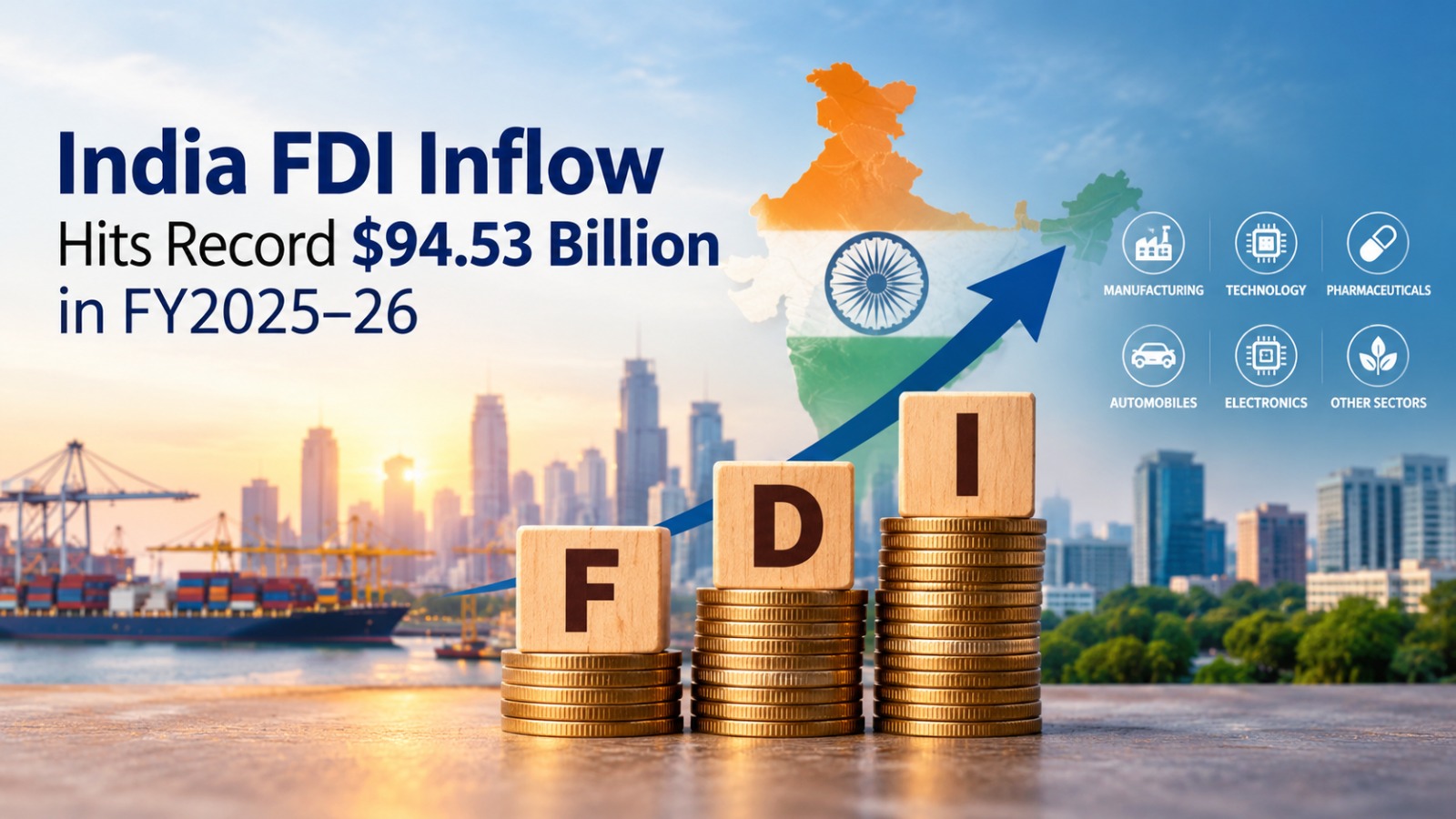
India FDI Hits Record $94.53 Billion in FY2025–26
India records a record $94.53 billion FDI in FY2025–26, highlighting growing investment, manufacturing and global business opportunities.
India has recorded its highest-ever annual Foreign Direct Investment (FDI) inflow of $94.53 billion in FY2025–26, highlighting the growing scale of international investment into the Indian economy. The latest figures were shared on September 25, 2026, as India marked the 12th anniversary of the Make in India initiative.
The development comes as India continues to attract investment across manufacturing, technology, pharmaceuticals, automobiles, electronics and other sectors. Cumulative FDI inflows from FY2014–15 through FY2025–26 have reached approximately $843 billion, according to the figures cited by the Commerce and Industry Ministry.
FDI Reaches a New High
The $94.53 billion inflow represents a new annual record for India. Foreign direct investment is important because it can bring not only capital but also technology, management expertise, global supply-chain connections and access to international markets.
The latest numbers indicate that international investors continue to allocate capital to Indian businesses and projects despite changes in the global economic environment. The record annual figure also adds to India's broader effort to strengthen its position as a manufacturing and investment destination.
Manufacturing Remains an Important Investment Driver
One of the major themes behind India's investment story is the expansion of domestic manufacturing. Government-linked production incentive programmes have been designed to encourage companies to manufacture products in India and expand production capacity.
According to figures reported by PTI and carried by Rediff, Production Linked Incentive (PLI) schemes have generated approximately ₹2.40 lakh crore in actual investment and more than 14.6 lakh direct and indirect jobs. Electronics, pharmaceuticals, automobiles and IT hardware are among the sectors that have benefited from the schemes.
The combination of foreign investment and domestic manufacturing incentives has the potential to strengthen India's role in global supply chains. For companies looking to diversify production locations, India represents one of the markets being considered for manufacturing and supply-chain expansion.
Technology and Industry Are Attracting Larger Investments
Investment activity in India is also extending beyond traditional manufacturing. Technology, digital infrastructure, artificial intelligence, electronics and other emerging industries are becoming increasingly important components of the country's investment landscape.
Recent business reporting indicates that India's technology funding has also remained significant in 2026, with investors showing interest in larger funding rounds and established companies.
This shift reflects the broader transformation of India's economy, where manufacturing and technology are increasingly interconnected. Investments in data infrastructure, digital services, AI and advanced manufacturing can support productivity while creating demand for skilled workers and specialised services.
India's Position in Global Supply Chains
Global companies are increasingly looking at supply-chain diversification as geopolitical uncertainty affects trade and access to critical resources.
This trend is also visible in Indian companies' overseas investment strategies. JPMorgan expects Indian outbound M&A activity to continue increasing as companies seek to secure supply chains and access resources such as critical minerals. Reuters reported that Indian outbound deals had already approached $24 billion in 2026, putting the year on track for a record level.
Together, inbound FDI and outbound acquisitions illustrate how Indian companies and international investors are becoming more connected to global markets.
What the Record FDI Figure Means for Businesses
The record FDI figure has implications for businesses operating in India. Greater foreign investment can increase competition, encourage technology adoption and create opportunities for domestic companies to become suppliers or strategic partners of multinational businesses.
For startups and smaller companies, increased investment into sectors such as technology, manufacturing, logistics and digital infrastructure can potentially expand the market for specialised services and business solutions.
However, FDI numbers alone do not determine the performance of individual industries or companies. Investment outcomes depend on factors such as demand, infrastructure, regulation, productivity, global economic conditions and the ability of businesses to deploy capital effectively.
Outlook for India's Investment Landscape
India's record $94.53 billion FDI inflow in FY2025–26 provides an important indicator of the country's growing role in the global investment landscape. With cumulative FDI reaching $843 billion since FY2014–15, international capital has become an increasingly important component of India's economic development.
The next phase will depend on how effectively investment is converted into productive capacity, exports, employment, innovation and stronger domestic supply chains. Manufacturing, technology, electronics, pharmaceuticals, automobiles and digital infrastructure are likely to remain important areas to watch as companies continue to evaluate India as part of their long-term growth strategies.
For investors and businesses tracking India's economy, the record FDI figure is therefore more than a single investment statistic. It provides a snapshot of India's expanding integration with global capital and production networks.
To Read More Such News Visit Startup Times .


Leave a comment
Your email address will not be published. Required fields are marked *
Add a newsletter to your widget area.
Top Stories