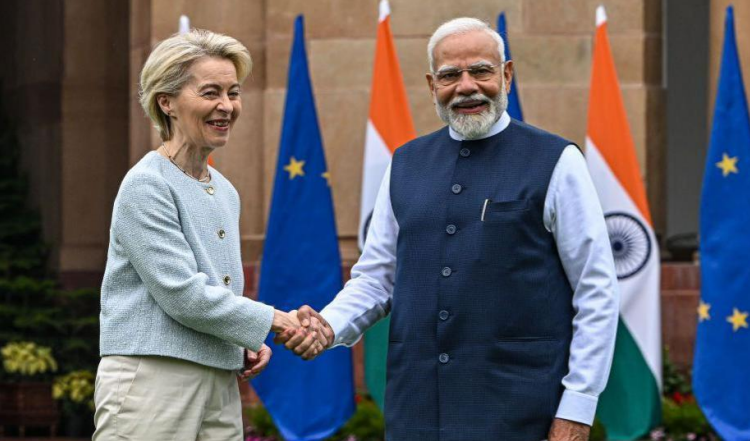
India is approaching one of the most consequential trade milestones in its modern economic history as negotiations for a comprehensive Free Trade Agreement (FTA) with the European Union enter their final stretch. Senior officials in New Delhi confirm that the long-awaited pact is now close to closure, with both sides accelerating discussions ahead of the high-profile India–EU Summit scheduled on January 27 in New Delhi.
According to Trade Secretary Rajesh Agrawal, the remaining issues are narrow enough that negotiators are “working with a sense of urgency” to deliver a near-final text before leaders from both sides arrive for the January summit. If completed, the agreement would mark India’s largest and most strategically significant trade partnership to date, opening the country’s 1.4-billion-strong consumer market more widely to the European bloc and strengthening India’s footprint in a shifting global trade landscape.
What the Trade Secretary’s Statement Signals
Trade Secretary Rajesh Agrawal’s confirmation that the India–EU trade pact is now “very close to being finalised” is more than a procedural update, it is a strategic message from the government at a pivotal moment. His statement reflects a rare level of optimism in negotiations that historically progressed slowly, indicating that both sides have aligned on key market access and regulatory issues after months of technical consultations.
The timing of his announcement is equally telling. With the India–EU summit nearby, Agrawal’s remarks are a deliberate signal that New Delhi intends to use the high-profile diplomatic platform to seal or showcase decisive progress on the agreement. It also suggests that India sees the deal as a cornerstone of its evolving trade strategy, one that reduces dependence on any single market and strengthens economic ties with a bloc that values regulatory stability and predictable frameworks.
Momentum Builds Ahead of a High-Stake Summit
The upcoming summit will bring a powerful European delegation to India, led by German Chancellor Friedrich Merz, alongside senior EU leadership. Their presence signals that Brussels views the agreement not just as a commercial opportunity but as a wider strategic partnership with an increasingly influential India.
Negotiations, which once moved at a cautious pace, have intensified to align with the diplomatic calendar. With global trade geopolitics growing more complex marked by tariff tensions, supply-chain disruptions, and an evolving U.S. trade stance both India and the EU see value in finalising a long-delayed pact that deepens their economic interdependence.
For Europe, gaining predictable access to India’s booming economy offers a major competitive advantage at a time when global markets are increasingly fragmented. For India, the pact represents a deliberate step toward diversifying its trade exposure and reducing vulnerability to unilateral tariff regimes.
Opening the Gates of a 1.4 Billion–Strong Market
One of the central pillars of the agreement is greater market access. European industries spanning automobiles, machinery, renewable energy, chemicals, and high-value manufacturing stand to gain from smoother entry into India’s fast-growing domestic market.
But the impact is not one-sided. The deal opens pathways for Indian exports, especially labour-intensive goods such as textiles, engineering products, pharmaceuticals, digital services, and agricultural value-added goods. A successful agreement would make the EU not only a major investor but also a crucial export destination for India’s production ecosystem.
Given the scale of both markets, analysts project that the pact could reshape bilateral trade dynamics for the next decade, paving the way toward more seamless business mobility, mutual regulatory alignment, and long-term supply-chain integration between India and Europe.
A Pact Negotiated in a Shifting Geopolitical Climate
The potential breakthrough comes at a time when global trade relations are in a state of realignment. Increasing tariff barriers, fluctuating policies among major economies, and geopolitical uncertainty have compelled nations to seek stable, balanced trade partnerships.
For India, the ongoing tariff strains with the United States underline the need for diversified economic alliances. The EU, meanwhile, is looking for reliable partners in Asia to counter disruptions in global supply chains and reduce overdependence on single-country sourcing.
The India–EU agreement, therefore, carries implications beyond tariffs and quotas. It represents a strategic convergence rooted in shared interests: economic resilience, access to advanced technologies, clean-energy cooperation, data governance, and secure supply chains in sensitive sectors.
The Road Ahead
As the January summit approaches, both sides are working to iron out the remaining text covering market access, regulatory standards, intellectual property rules, services mobility, and sustainability frameworks. Even if the final signatures extend beyond the summit, officials maintain that the process has reached a decisive stage.
The broader message is unmistakable: India and the European Union are positioning themselves for a deeper, more balanced economic partnership that responds to the evolving dynamics of global trade and geopolitical competition.
Once signed, the pact is expected to become a cornerstone of India’s international economic engagement, strengthening its export capacity, enhancing investor confidence, and signalling that India is ready to assume a larger role in shaping global trade architecture.