
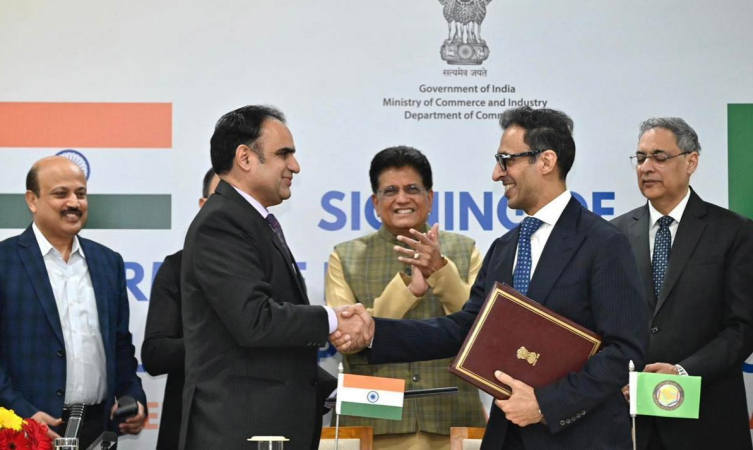
India and the Gulf Cooperation Council have formally executed a landmark Memorandum of Understanding (MoU) establishing the Terms of Reference for long-awaited Free Trade Agreement (FTA) negotiations, marking the most substantial advancement in India–Gulf economic relations in almost two decades. The announcement was made today following a coordinated release by India’s Ministry of Commerce and the GCC Secretariat, signalling renewed political will to advance a trade framework that had remained stalled since initial talks began in 2004.
The development is seen as strategically vital given the scale of India–GCC economic engagement, which reached approximately USD 175 billion in annual trade during the last recorded financial year. Officials on both sides stated that structured negotiations will begin within the next two months, setting the stage for a comprehensive agreement that may cover goods, services, investment, labour mobility and digital trade. The MoU outlines a negotiation track designed to remove bottlenecks that previously impeded talks and to accelerate convergence on new economic priorities in the region.
Strategic Importance of the Renewed Engagement
The revival of India–GCC FTA negotiations comes at a time when both sides are undergoing internal economic restructuring. India is expanding its global manufacturing footprint under the Production-Linked Incentive programmes, while GCC states spearhead national transformation strategies to diversify beyond oil. Officials involved in the drafting of today’s MoU described it as a “critically timed economic intervention” that aligns with mutual growth goals shaped by shifting global supply-chain dynamics.
Senior members from India’s negotiation team emphasised that this renewed FTA track is intended to be “strictly time-bound and outcome-driven,” noting that the Terms of Reference provide precise thematic blocks for upcoming negotiation sessions. Gulf officials made similar remarks, stressing that the agreement reinforces their commitment to strengthening ties with India’s fast-growing market and its central role in regional energy, labour and logistics corridors.
Economic Stakes and Market Expansion Potential
Data from the last fiscal cycle shows that the GCC is among India’s top trade partners, with the UAE and Saudi Arabia accounting for the largest shares. Indian exports to the Gulf include engineering goods, food products, pharmaceuticals, apparel and petrochemicals, while imports are dominated by crude oil, LNG, metals and fertilisers. Industry analysts estimate that a successful FTA could lower tariffs on up to 85% of traded goods, significantly improving India’s export competitiveness across the bloc.
For GCC member states, the FTA offers expanded access to India’s consumer and industrial markets, with additional opportunities in energy partnerships, advanced manufacturing, green hydrogen, and technology transfer. Officials familiar with early negotiation contours stated that both sides see the agreement as an instrument to streamline regulatory alignment and expedite investment flows, particularly in infrastructure, fintech, AI systems, and large-scale industrial projects.
Statements and Diplomatic Signals
Following the announcement, India’s Commerce Secretary stated that the agreement “establishes a forward-leaning negotiation framework intended to create measurable outcomes within 2026.” He noted that both delegations have committed to predictable review cycles and a rapid schedule for the first negotiation round. A senior GCC trade advisor described today’s MoU as “a recalibrated blueprint” for a trade partnership that reflects the economic realities of the current decade.
Diplomats also highlighted the geopolitical significance of the development. With volatile energy markets, shifting global trade alignments and intensifying competition for investment capital, both regions see this negotiation as foundational to strengthening long-term strategic stability. Observers noted that the MoU comes at a time when Gulf states are expanding global diversification agendas, while India seeks stronger integration into global supply chains amid its sustained economic growth.
Key Provisions of the MoU and Roadmap Ahead
• Establishes a detailed Terms of Reference for structured negotiations, including timelines and thematic committees
• Creates sector-specific working groups covering goods, services, digital trade, labour mobility and investment
• Sets a 60–75 day window for Round One negotiations
• Outlines regulatory cooperation on standards, customs processes and intellectual property
• Includes monitoring mechanisms for quarterly progress evaluation
These provisions form the operational backbone that will guide the negotiation process through 2026.
Implications for Growth, Policy and India–GCC Relations
The MoU’s signing holds far-reaching implications for India’s growth strategy. Gulf countries collectively host over 8.5 million Indian workers whose remittances play a crucial role in India’s domestic economy, and a more structured labour-mobility framework could boost both worker protections and recruitment efficiency. The agreement is also expected to attract greater Gulf sovereign wealth investments into Indian infrastructure, clean-tech and manufacturing projects.
On the GCC side, the partnership strengthens access to India’s expanding manufacturing base, its rising middle-class consumption market, and its growing emphasis on renewable energy. Analysts forecast that an operational FTA could drive total bilateral trade beyond USD 200 billion annually, provided tariff reforms and regulatory alignment are executed smoothly. Policy experts said the agreement could become one of the most consequential components of India’s long-cycle economic diplomacy.
Conclusion
The MoU signed today marks a pivotal moment in India–GCC relations, setting in motion a formal negotiation process that is expected to shape the economic landscape of both regions for the next decade. With clearly defined goals, structured negotiation timelines and strong political endorsement, the agreement creates a foundation for meaningful progress toward a comprehensive FTA. If successfully concluded, the treaty could significantly enhance trade flows, elevate India’s global competitiveness and reinforce the Gulf bloc’s diversification agenda, positioning the partnership as one of the most strategically influential trade relationships of the current global cycle.