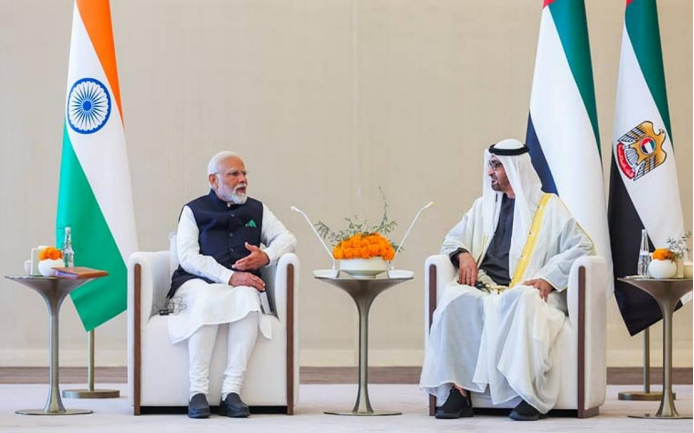
India placed security cooperation firmly at the heart of its engagement with the United Arab Emirates during President Sheikh Mohamed bin Zayed Al Nahyan’s visit to New Delhi on January 19, signalling a decisive shift from transactional defence exchanges to a structured strategic partnership.
Prime Minister Narendra Modi and UAE President Sheikh Mohamed bin Zayed Al Nahyan agreed to initiate work towards a comprehensive Strategic Defence Partnership, aimed at expanding cooperation in joint training, defence manufacturing, military education, cybersecurity and counter-terrorism.
From India’s perspective, the move reflects a broader recalibration of defence diplomacy with trusted partners beyond its immediate neighbourhood. Indian officials indicated that closer defence coordination with the UAE enhances maritime and regional security across the western Indian Ocean, while also supporting India’s ambitions to become a defence manufacturing hub.
Strategic Defence Push
According to Indian officials, the proposed defence plan covers joint military training, defence education, maritime security cooperation, cybersecurity, special forces engagement, and collaboration between defence industries. India sees the partnership as an opportunity to expand co-development and co-production of defence equipment, aligning with its broader push to reduce import dependence and build export capacity under its domestic defence manufacturing programme.
The agreement also strengthens intelligence sharing and counter-terrorism coordination, reflecting shared concerns over regional instability and non-state security threats.
New Delhi was careful to underline that the defence framework does not involve troop deployment or alignment in regional conflicts. Instead, Indian policymakers described it as a stability-focused partnership designed to protect sea lanes, enhance deterrence, and deepen trust with a key Gulf partner that sits at the crossroads of global energy and trade routes.
$3 Billion LNG Deal Anchors India’s Long-Term Energy Strategy
Energy security formed the economic backbone of the visit, with India finalising a landmark 10-year liquefied natural gas agreement valued at approximately $3 billion. Under the deal, ADNOC Gas will supply 0.5 million tonnes of LNG annually to Hindustan Petroleum Corporation Limited, beginning in 2028.
From India’s standpoint, the agreement provides long-term supply assurance at predictable pricing, shielding the economy from the sharp volatility that has disrupted global gas markets in recent years. The deal also deepens India’s energy diversification strategy, complementing supplies from Qatar, Australia and the United States, while reinforcing the UAE’s role as one of India’s most trusted energy partners.
With this agreement, the cumulative value of UAE LNG commitments to Indian companies now exceeds $20 billion.
Indian officials emphasised that natural gas will play a critical transitional role as India balances rapid economic growth with climate commitments, making long-duration LNG contracts strategically important rather than optional.
Trade and Investment Momentum
India used the visit to push an ambitious economic agenda, reaffirming a joint target to double bilateral trade from roughly $100 billion to $200 billion by 2032. The focus, however, has shifted from pure trade volumes to long-term investment and infrastructure-led growth.
A major outcome was the agreement to explore UAE participation in the Dholera Special Investment Region in Gujarat, a large-scale industrial and logistics hub that includes plans for a greenfield airport, port infrastructure, rail connectivity, manufacturing clusters and a smart urban township.
For India, UAE involvement brings not just capital but expertise in ports, logistics, industrial zones and urban planning.
Financial cooperation was also strengthened through the expansion of UAE institutions into GIFT City, reinforcing India’s ambition to position the centre as a regional financial gateway linking South Asia with the Gulf and beyond.
Technology, Space and Nuclear Cooperation Widen the Agenda
India ensured that the partnership extended well beyond conventional sectors. The two sides agreed to expand cooperation in space, including joint commercial projects, satellite programmes, launch infrastructure and industry-driven innovation. India views such collaboration as a way to accelerate the growth of its space economy while integrating global partners into its ecosystem.
Technology cooperation featured prominently, with discussions covering supercomputing infrastructure, artificial intelligence, data centres and digital public platforms. India also proposed the concept of “digital embassies”, reflecting its push to integrate technology into diplomacy and governance.
Civil nuclear cooperation marked another forward-looking dimension. Following India’s updated nuclear framework, both countries agreed to explore collaboration in advanced nuclear technologies, including large reactors and small modular reactors, as well as safety, operations and maintenance.
For India, nuclear energy remains central to its long-term clean energy mix, and engagement with financially strong partners like the UAE is seen as strategically valuable.
People-to-People Ties and India’s Strategic Outlook
India placed strong emphasis on the human dimension of the relationship, recognising the presence of more than three million Indians in the UAE. Discussions covered smoother recognition of Indian educational qualifications, digital verification of documents, expanded education partnerships and cultural initiatives aimed at deepening societal ties.
At the strategic level, the leaders exchanged views on regional and global developments, reiterating a shared commitment to combating terrorism and supporting stability through dialogue and multilateral cooperation.
India highlighted the importance of reliable partnerships in West Asia as global geopolitics becomes more fragmented, while the UAE reaffirmed its support for India’s growing role in global forums.
From New Delhi’s perspective, the January 19 visit delivered clarity of intent. By anchoring the relationship around defence planning and long-term energy security while simultaneously expanding cooperation in technology, infrastructure and people-centric initiatives, India signalled that the UAE is no longer just a key economic partner, but a central pillar of its West Asia strategy for the coming decade.