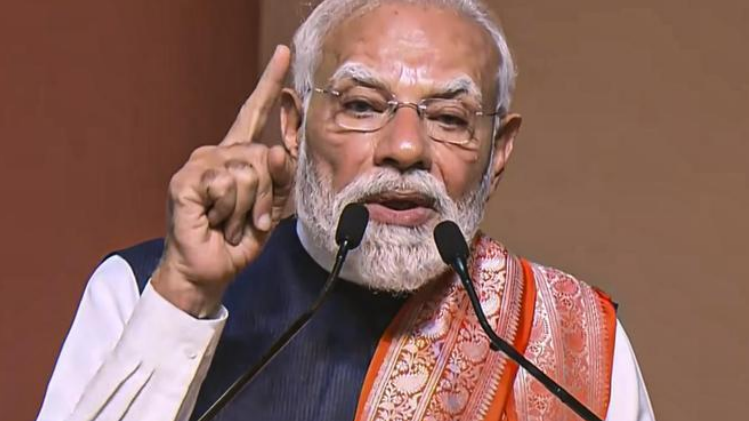
Prime Minister Narendra Modi on Sunday, at the conference of chief secretaries, said that India is undergoing a phase of “next-generation reforms,” arguing that the country’s current policy direction is not merely focused on incremental change but on structurally reshaping governance, the economy, and state capacity for the decades ahead.
Speaking at a public address attended by policymakers, industry representatives, and senior officials, the Prime Minister framed ongoing reforms as foundational steps aimed at preparing India for a rapidly changing global order.
In his remarks, Modi said that earlier phases of reform were largely centred on liberalisation and market access, whereas the present phase is designed to build systems that are transparent, technology-driven, and citizen-focused. He highlighted that reforms today are increasingly being implemented through digital platforms, institutional restructuring, and long-term policy consistency rather than short-term administrative fixes. According to him, this shift reflects a broader ambition to move India from policy intent to measurable outcomes on the ground.
The Prime Minister pointed to governance reforms as a central pillar of this transformation. He said that digital public infrastructure—including platforms for direct benefit transfers, taxation, identity verification, and service delivery—has reduced leakages, improved efficiency, and expanded access to government schemes. By minimising discretionary layers and relying on technology, the government aims to create a more predictable and rules-based administrative environment, which he described as essential for public trust and economic stability.
Economic reforms formed a key part of the address, with Modi stressing that policy efforts are now focused on strengthening domestic manufacturing, improving logistics, and enhancing ease of doing business. He said initiatives such as production-linked incentives, infrastructure expansion, and labour and tax reforms are intended to make India more competitive globally while generating employment at home. Rather than relying solely on consumption-led growth, he said the emphasis is on building resilient supply chains and expanding India’s role in global production networks.
The Prime Minister also underlined the importance of reforms in social sectors, particularly education, skilling, and healthcare. He argued that demographic advantage can only translate into economic strength if supported by modern institutions and future-ready skills. According to him, reforms in education policy, digital learning, and vocational training are aimed at aligning India’s workforce with emerging technologies, including artificial intelligence, advanced manufacturing, and clean energy.
Modi placed strong emphasis on institutional continuity, stating that next-generation reforms require patience and sustained execution rather than frequent policy reversals. He said reforms are being designed with a long-term horizon, allowing businesses, states, and citizens to plan with greater certainty. In this context, he called for cooperative federalism, noting that the success of reforms ultimately depends on coordination between the Centre and states.
The Prime Minister also linked reforms to India’s global positioning, stating that a stronger domestic framework enhances the country’s credibility on the international stage. He said India’s growing role in global forums, trade discussions, and strategic partnerships is closely tied to its internal economic strength and governance standards. According to him, next-generation reforms are not only about domestic outcomes but also about shaping India’s voice and influence globally.
Analysts note that the framing of reforms as “next-generation” signals an attempt to move beyond headline policy announcements toward deeper structural change. While some reforms have already shown tangible outcomes—particularly in digital governance and infrastructure—others remain works in progress, requiring sustained political will and administrative capacity. The success of this phase will likely be judged by its ability to deliver inclusive growth, reduce regional disparities, and maintain fiscal discipline while expanding public investment.
Looking ahead, Modi said the reform process will continue to evolve in response to technological change, demographic shifts, and global economic uncertainty. He argued that adaptability itself must become a core feature of governance, allowing institutions to respond quickly without losing accountability. The Prime Minister concluded by saying that the current reform cycle is laying the groundwork for a more confident, self-reliant, and competitive India, positioning the country to meet future challenges with greater resilience.
For supporters, the speech reinforces the government’s narrative of long-term nation-building through structural reform. For critics and observers, it sets benchmarks against which policy outcomes will be measured in the years ahead. What remains clear is that the language of “next-generation reforms” reflects an ambition to redefine how India governs, grows, and engages with the world in the coming decades.